
In a small organization, following up on a policy acknowledgment or overdue task may be as simple as sending an email or asking a team member directly. That approach becomes much harder when an organization has multiple departments, facilities, locations, managers, and responsibilities.
A policy update may affect several teams at once. Training may need to be completed by specific employees. Corrective actions may have different deadlines and owners. Meanwhile, leadership still needs visibility into whether these responsibilities have actually been completed.
Without a centralized process, accountability can become dependent on spreadsheets, email chains, calendar reminders, and individual follow-ups. Important tasks can be overlooked, duplicated, or difficult to verify later.
This is where automated tracking can help close the gap between assigning a responsibility and proving that it was completed.
Automated Reminders Keep Responsibilities Moving
One of the most practical benefits of automation is consistency. Instead of relying on someone to remember when a policy acknowledgment or compliance task is due, an automated system can generate timely notifications and reminders.
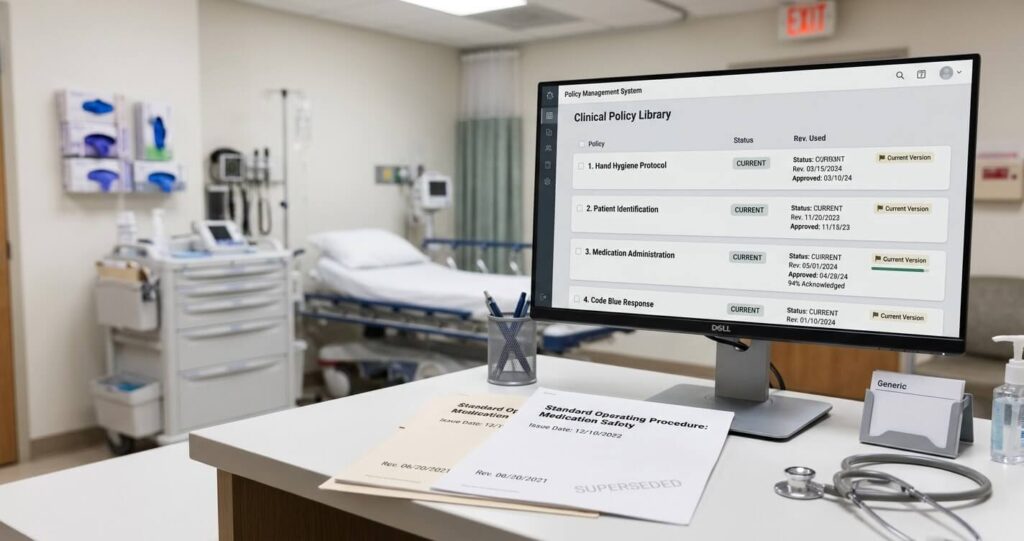
For example, when a policy is revised, the appropriate employees can receive a notice directing them to the current version and any associated training or testing. Follow-up reminders can help address outstanding acknowledgments rather than leaving administrators to manually monitor every response.
ComplyVision supports this type of workflow through alerts, notifications, policy distribution, and task management. Its platform can send notices with direct access to standards, policies, and related training materials, while acknowledgment activity can be tracked for greater accountability.
Automation does not replace employee responsibility. Instead, it creates a more reliable structure for reminding people about the responsibilities they already have.
Policy Acknowledgment Should Be More Than a Checkbox
Acknowledging a policy is an important part of demonstrating that information was communicated. However, organizations may need more than a simple record showing that someone clicked a button.
A stronger process connects the policy to the employee, required training, testing, and relevant follow-up activities. This creates a clearer record of what information was provided and what actions were expected.
ComplyVision allows acknowledgments to be associated with testing and score recording, helping organizations move beyond simply distributing documents. The platform also records access and actions, creating an auditable history around policy and compliance activities.
For organizations managing numerous policies across multiple departments, this level of tracking can make it easier to identify where additional education, clarification, or follow-up may be needed.
Centralized Task Management Creates Visibility
Accountability becomes much stronger when leaders can see the status of responsibilities from a centralized location.
Instead of asking several department managers for separate updates, organizations can use dashboards, reports, alerts, and workflow tools to monitor compliance activities. This can help identify overdue tasks, outstanding acknowledgments, corrective actions, and other areas requiring attention.
ComplyVision is designed to centralize compliance information and provide real-time visibility across organizational structures. Its capabilities include dashboards, scheduled reporting, task acknowledgments, alerts, notifications, corrective actions, and staff preparedness tools.
This visibility can also support better decision-making. Leadership can focus attention where it is most needed rather than spending valuable time manually gathering status updates.
Connecting Departments Helps Reduce Operational Gaps
Multi-department organizations often face another challenge: one team’s responsibility may directly affect another team’s work.
For example, a regulatory change may require a policy update, employee training, operational changes, and management verification. If those activities are tracked separately, there is a greater possibility that one step will be missed.
A connected workflow can help organizations associate regulations with policies, control steps, tasks, training, and related documentation. ComplyVision is built around these connections, helping organizations manage compliance processes across departments and facilities while maintaining centralized records.
The result is a more structured accountability loop: assign, notify, acknowledge, complete, monitor, and report.
Build a Culture of Continuous Accountability
Automation works best when it supports a broader culture of accountability. Employees need to understand not only that a task has been assigned, but why it matters and how their responsibilities contribute to organizational goals.
We believe effective compliance should be integrated into daily operations rather than treated as a last-minute preparation exercise before an audit or inspection. ComplyVision helps organizations connect policies, standards, procedures, training, tasks, and reporting within a centralized environment designed to support ongoing readiness.
For organizations operating across multiple departments, facilities, or jurisdictions, automated task management and policy acknowledgment tracking can provide the structure needed to close accountability gaps. We at ComplyVision help organizations strengthen compliance, policy management, staff readiness, and operational tracking across healthcare and other complex environments throughout the United States and beyond. If you are looking for a more organized approach to automated task management and policy acknowledgment tracking in the U.S., including neighboring regions and multi-location operations, contact us at inquiries@filevision.net to learn how we can help.