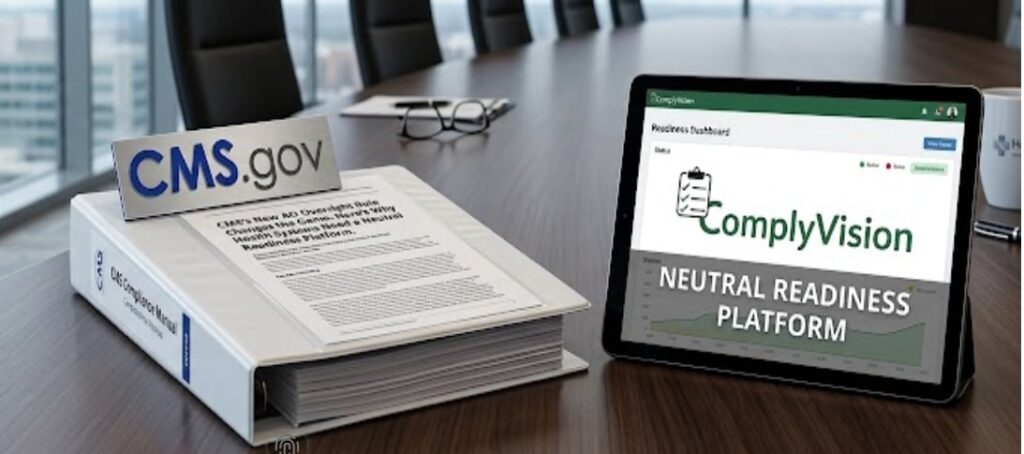
The Centers for Medicare & Medicaid Services (CMS) has finalized a major overhaul of how it oversees accrediting organizations (AOs) – the entities that “deem” thousands of hospitals and providers to meet Medicare’s Conditions of Participation.
On the surface, the headlines are about conflict‑of‑interest limits and tougher AO performance monitoring. Underneath, the rule fundamentally changes how health systems should think about survey readiness, AO relationships, and the tools they rely on to stay compliant.
This is exactly the world ComplyVision was built for.

What CMS is doing – and why it matters
For years, CMS has been worried about two things:
- AOs that accredit and consult the same facilities
- Inconsistent survey practices and interpretations across the country
The new rule tightens both:
- Conflict‑of‑interest restrictions. AOs face new limits on when they can provide fee‑based consulting and mock surveys to the same organizations they accredit, especially around initial surveys, re‑accreditation windows, and AO‑received complaints.
- Unannounced survey expectations. CMS is codifying policies that make surveys truly unannounced – eliminating practices like pre‑arrival notifications and blackout dates that gave organizations time to “stage” compliance.
- Standardized surveyor training. AO surveyors must now complete the same CMS basic training used for state surveyors, pushing interpretations closer to federal language and expectations.
- Stronger AO oversight. CMS will be using direct‑observation validation surveys and public correction plans to hold AOs accountable for inconsistency or under‑performance.
In simple terms: CMS is saying “no more mixed incentives and no more episodic cram‑sessions.”
Why the old AO‑centric readiness model breaks
Historically, many organizations solved accreditation anxiety by buying more from their AO:
- AO‑delivered mock surveys
- AO‑branded readiness tools
- AO consulting to “get ready” for the AO’s own surveyors
In the new environment, that pattern looks increasingly risky:
- The rule explicitly restricts some of those consulting activities in defined time windows.
- CMS is watching more closely for real or perceived conflicts between accreditation and revenue‑generating services.
- Surveyors arriving unannounced have less tolerance for “show day” compliance that looks different from daily practice.
The result: health systems still need expert guidance and tooling, but they must be careful about who provides it, when, and under what incentives.
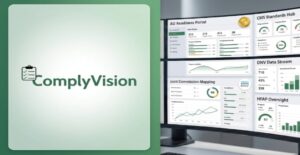
ComplyVision’s role: a conflict‑free readiness operating system
ComplyVision was designed to sit next to AOs and state survey agencies, not inside them.
Key principles:
- We are not an accrediting organization. ComplyVision does not make deeming decisions and does not participate in accreditation determinations.
- We don’t sell AO consulting. We’re not the same entity that surveys you; we’re the platform that helps you stay ready for whoever does.
- We are AO‑agnostic and vendor‑neutral. We support Joint Commission, DNV, HFAP, and others – and we don’t steer you toward a particular AO or third‑party product.
That independence matters more now that CMS is tightening the rules on the AO side.

What ComplyVision actually does for health systems and IDNs
- Turns standards into daily work ComplyVision maps Medicare Conditions and AO standards into structured obligations, owners, and tasks. Instead of a binder or PDF manual, you get:
- Standard‑by‑standard responsibilities
- Automated tasking and reminders
- Evidence capture linked directly to the requirement it supports
- You move from “Where is that requirement?” to “Show me the current status and evidence for this standard.”
- Centralizes evidence and corrective actions When an issue is identified – by frontline staff, internal tracers, or an external survey – ComplyVision:
- Captures the finding with context
- Assigns and tracks corrective actions
- Stores documentation of what changed and when
- Keeps a time‑stamped history you can show to CMS, state agencies, and any AO
- That record matters when validation surveys and public AO performance reporting put more emphasis on sustained correction, not just quick fixes.
- Supports true “survey‑ready every day” operations With unannounced surveys and no blackout dates, health systems need to assume “today could be the day.” ComplyVision helps by:
- Providing real‑time dashboards by facility, service line, standard, and risk level
- Highlighting overdue tasks, gaps in evidence, and repeat findings
- Giving leaders a single view across hospitals, clinics, and service lines
- Instead of scrambling when the AO calls, you can open ComplyVision and already see where you stand.
- Gives the C‑suite and boards transparent oversight The stakes of AO performance and CMS oversight are now enterprise‑level risks. ComplyVision:
- Rolls up readiness metrics across the system
- Links accreditation risk to quality, safety, and financial implications
- Provides board‑friendly and executive views, not just accreditation‑team detail
- That makes it easier to treat accreditation not as a compliance cost center, but as a core element of enterprise risk management.
When you’re explaining ComplyVision in the context of the new CMS rule, these points resonate with executives, compliance leaders, and legal:
- “The new AO rule doesn’t ban accreditor‑branded tools, but it does put a spotlight on conflicts between accreditation, consulting, and commercial products. We want our readiness platform to be clearly outside that conflict zone.”
- “ComplyVision is our independent operating system: it helps us stay ready for CMS, state survey agencies, and any AO, without being tied to deeming decisions or restricted consulting windows.”
- “We expect more unannounced surveys and more standardized surveyor expectations. That’s why we’re investing in continuous readiness workflows, not one‑time AO mock surveys.”
CMS’s AO oversight rule is about more than compliance fine print; it’s a signal about the future of accreditation: independent, conflict‑aware, and continuous.
ComplyVision gives health systems and IDNs a way to live in that future today – by separating the engine that runs your readiness from the organizations that judge it.
If you’re reviewing your AO contracts or rethinking your readiness model, now is the right time to put a neutral platform at the center of your strategy.
LinkedIn post – Hospital C‑suite audience
CMS’s new AO oversight rule just changed the accreditation risk profile for every health system CEO, COO, CMO, CNO, and CFO.
The rule tightens conflict‑of‑interest restrictions on accrediting organizations, restricts when they can sell consulting and mock surveys to the same facilities they accredit, and codifies truly unannounced surveys with standardized surveyor training.
In other words, the old playbook of “buy another AO mock survey, sprint for 90 days, then exhale” is no longer sustainable.
For the C‑suite, this isn’t just a compliance nuance. It touches:
- Enterprise risk: AO performance, CMS oversight, and survey findings now sit squarely on the board and executive agenda.
- Operating model: Survey readiness has to be embedded in daily operations, not treated as a one‑off event before the triennial survey.
- Vendor strategy: Any AO‑linked consulting or software now gets a harder look through a conflict‑of‑interest lens.
That’s why we’re positioning ComplyVision as a neutral readiness operating system for hospitals and IDNs:
- Independent: ComplyVision is not an accrediting organization and does not participate in deeming decisions.
- AO‑agnostic: We support Joint Commission, DNV, HFAP, and state survey frameworks without steering you toward any one AO.
- Continuous: We turn Medicare Conditions and AO standards into ongoing workflows, evidence management, and corrective‑action tracking, so leadership can see – at any moment – where each facility stands.
If you’re revisiting AO contracts, rethinking reliance on AO‑branded consulting/software, or being asked by your board, “Are we truly survey‑ready every day?”, it may be time to put an independent platform like ComplyVision at the center of your strategy.