
Most healthcare organizations have no shortage of policies.
There are clinical procedures, employee guidelines, HIPAA policies, emergency protocols, infection control procedures, and countless other documents that help keep daily operations running smoothly. The challenge is not always creating these policies. Sometimes, the bigger challenge is making sure everyone is actually using the right version.
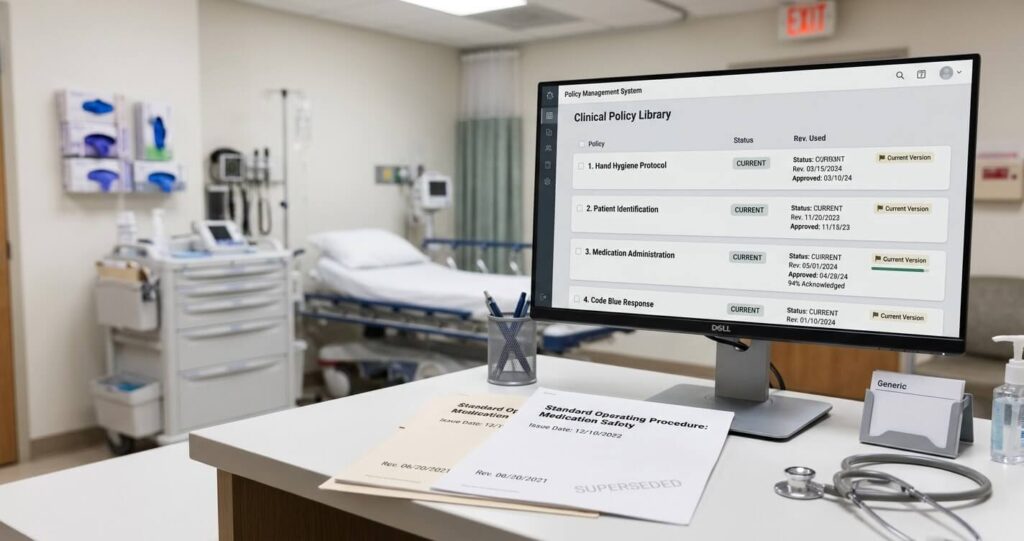
Imagine a nurse finding a procedure in an old shared folder. Another employee has a printed copy in a department binder. Meanwhile, the compliance team has already approved a newer version.
Nobody intended to create a problem. Yet now three versions of the same procedure may be circulating.
That quiet disconnect can become a serious concern when the policy affects patient care, privacy, documentation, or regulatory compliance.
A Small Version-Control Problem Can Become a Bigger Issue
An outdated SOP does not necessarily look dangerous.
It may be missing one recently changed instruction. Perhaps a responsibility has moved to another department, a documentation requirement has changed, or a process has been updated based on new organizational or regulatory expectations.
On paper, the difference may look minor.
In practice, however, small differences can lead employees to handle similar situations differently. In healthcare, consistency matters because staff often need clear instructions when making decisions quickly.
The risk is not simply that an employee has an old document. The bigger issue is that leadership may believe a new procedure is being followed when the day-to-day reality is different.
Why Audit Day Should Not Be the Finish Line
It is easy to think about compliance in terms of an upcoming survey or audit.
Someone checks the policies, confirms that required documents exist, organizes records, and prepares employees for questions. But compliance cannot stop once the auditor leaves.
CMS maintains Conditions of Participation and Conditions for Coverage that establish health and safety requirements for participating healthcare organizations. HIPAA also requires covered entities to maintain appropriate policies and procedures and, where applicable, update them as circumstances change.
The practical question is therefore not just, “Do we have the policy?”
It is also:
“Is the current policy reaching the people who need it?”
That distinction can make a major difference.
Centralizing Policies Makes the Right Information Easier to Find
One of the simplest ways to reduce confusion is to give employees a reliable place to find current policies.
When documents are scattered across email attachments, personal computers, shared drives, and physical binders, employees may not know which copy is authoritative. Even well-intentioned staff members can end up relying on something that looked current when they saved it.
A centralized policy system can provide a clearer process.
Organizations can establish one controlled location for approved policies while tracking important details such as the document owner, approval date, effective date, revision history, and current version.
That gives employees a straightforward answer when they need to know, “Which policy am I supposed to follow?”
Publishing an Update Is Only Part of the Process
Updating a policy is one step. Making sure employees know about the change is another.
For policies that directly affect a person’s responsibilities, organizations can build staff acknowledgment into the workflow. When a policy changes, affected employees can receive a notification, review the updated document, and acknowledge that they have received it.
For more significant changes, additional training or testing may make sense.
This creates a useful chain of accountability:
Policy updated → employee notified → policy reviewed → acknowledgment recorded.
That process is much easier to manage when acknowledgments and policy records are connected instead of being tracked manually across spreadsheets and email.
Regulations Change, So Policies Need Room to Change Too
Healthcare compliance is not static.
Organizations may need to respond to changes in federal requirements, CMS expectations, HIPAA-related guidance, state requirements, accreditation standards, or their own internal processes.
HHS guidance, for example, emphasizes the importance of reviewing and updating HIPAA policies and procedures when environmental or organizational changes occur.
That means a policy repository should not simply be a digital filing cabinet. It should support an ongoing process for reviewing, updating, approving, distributing, and tracking policies.
The goal is to make keeping policies current part of normal operations rather than a last-minute project before an audit.
Making Compliance Part of Everyday Care
Ultimately, policy management is not really about having more documents.
It is about helping people know what they are supposed to do.
When employees can quickly find the current procedure, understand what changed, and confirm that they have reviewed it, compliance becomes much more connected to everyday work. That can help organizations reduce confusion while creating a clearer record of how policies are managed.
At ComplyVision, we help healthcare organizations bring these pieces together through a centralized compliance platform designed to manage policies, procedures, training, testing, audits, dashboards, reminders, and regulatory requirements. Our goal is to make compliance easier to manage as part of everyday operations—not something organizations scramble to organize when an audit is approaching. For organizations looking for healthcare compliance solutions in Atlanta and surrounding areas, including neighboring communities throughout Georgia, we’re here to help. Contact us at inquiries@filevision.net to learn more about ComplyVision and how we can support your compliance workflow.