
Moving freight across state borders and international lines creates more than logistical challenges. It can also introduce layers of regulatory requirements, documentation obligations, safety procedures, and accountability standards. When those requirements are managed through disconnected spreadsheets, email threads, or static policy binders, it becomes much harder to know whether the right information is reaching the right people at the right time.
A centralized compliance framework can provide a more reliable approach. Instead of treating compliance as a collection of documents, organizations can make it an active process supported by digital records, automated alerts, controlled policies, and ongoing monitoring.
Why Multi-Jurisdiction Shipping Creates Compliance Risk
Transportation requirements can change depending on where goods originate, where they are transported, and where they ultimately arrive. Different jurisdictions may impose different documentation, safety, reporting, or operational requirements.
For organizations managing multiple routes, facilities, vendors, or transportation partners, keeping track of these differences manually can create gaps. An employee may rely on an outdated procedure, a required acknowledgment may be missing, or an important regulatory update may not reach everyone who needs it.
The problem is not necessarily a lack of policies. It is often a lack of centralized control over those policies.
Centralize Policies and Regulatory Requirements
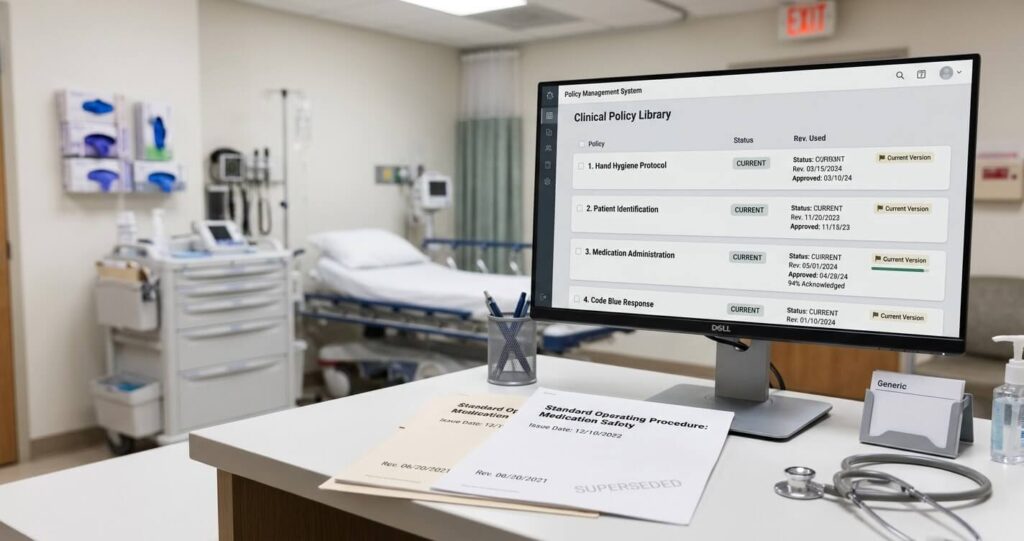
A strong framework begins with a controlled source of information. Instead of maintaining multiple versions of procedures in different locations, organizations can establish a centralized system for managing policies, standards, related documentation, and required actions.
ComplyVision, for example, is designed around centralized compliance management, with tools for managing policies, standards, procedures, alerts, notifications, training, and reporting. Its platform also supports federal, state, local, industry, and accreditation standards, demonstrating how different requirements can be organized within one compliance environment.
For a transportation organization, the same principle can help establish clearer ownership and reduce uncertainty about which requirements and procedures are currently applicable.
Use Automated Alerts Instead of Manual Reminders
A compliance program becomes much stronger when important actions do not depend entirely on someone remembering to send an email or check a spreadsheet.
Automated alerts can notify responsible personnel when policies change, acknowledgments are required, training needs to be completed, or corrective actions need attention. This creates a more proactive approach to compliance rather than waiting for an inspection or incident to expose a gap.
ComplyVision incorporates alerts, notifications, automated reminders, dashboards, and scheduled reports to support ongoing accountability.
For organizations operating across jurisdictions, this type of automation can make it easier to maintain consistent processes while still tracking requirements that may differ between locations.
Build a Digital Record for Inspections
When an inspection occurs, being compliant is only part of the challenge. Organizations may also need to demonstrate what policies were in place, who received them, what training occurred, and how corrective actions were handled.
Digital record-keeping can make that evidence easier to locate. A centralized system can maintain records of policy access, acknowledgments, actions, and related compliance activity instead of requiring staff to reconstruct information from multiple sources.
ComplyVision specifically records access and actions within its system and provides audit-ready information, helping organizations maintain greater visibility into compliance activity.
Keep Policy Distribution Consistent
A regulatory update is only useful when it reaches the people responsible for following it.
Real-time policy distribution helps reduce the risk of employees continuing to use outdated procedures. Instead of manually distributing revised documents across departments or locations, organizations can use controlled publishing and notification processes.
This approach is particularly valuable when operations involve multiple facilities, teams, or jurisdictions. ComplyVision supports proactive distribution and publishing, including notices and reminders connected to standards, policies, and related training materials.
Turn Compliance Into an Ongoing Process
The goal of a centralized compliance framework is not simply to prepare for an inspection. It is to make compliance part of everyday operations.
We believe organizations are better positioned to manage risk when compliance information is centralized, responsibilities are visible, updates are distributed efficiently, and records are continuously maintained. ComplyVision is built around this proactive approach, helping organizations manage policies, standards, training, risks, corrective actions, and reporting through one structured platform.
For organizations seeking a centralized compliance framework for multi-jurisdiction shipping and other complex regulatory environments, ComplyVision provides a centralized, cloud-based approach to compliance management designed to support organizations across the U.S. and international environments. We help organizations improve policy control, regulatory tracking, accountability, and inspection readiness. Contact us at inquiries@filevision.net to learn how ComplyVision can support a more organized and proactive compliance strategy.