
Distributing a policy does not necessarily mean employees understand it. A staff member may open a document, click an acknowledgment box, and move on without remembering the details when they actually need to apply them. For organizations managing complex regulations, multiple departments, or multiple locations, this creates a gap between policy awareness and operational readiness.
We believe modern compliance workflows should do more than document that a policy was distributed. They should help organizations determine whether employees understand expectations, complete required training, and remain prepared as policies and standards evolve.
Why Passive Policy Reading Is No Longer Enough
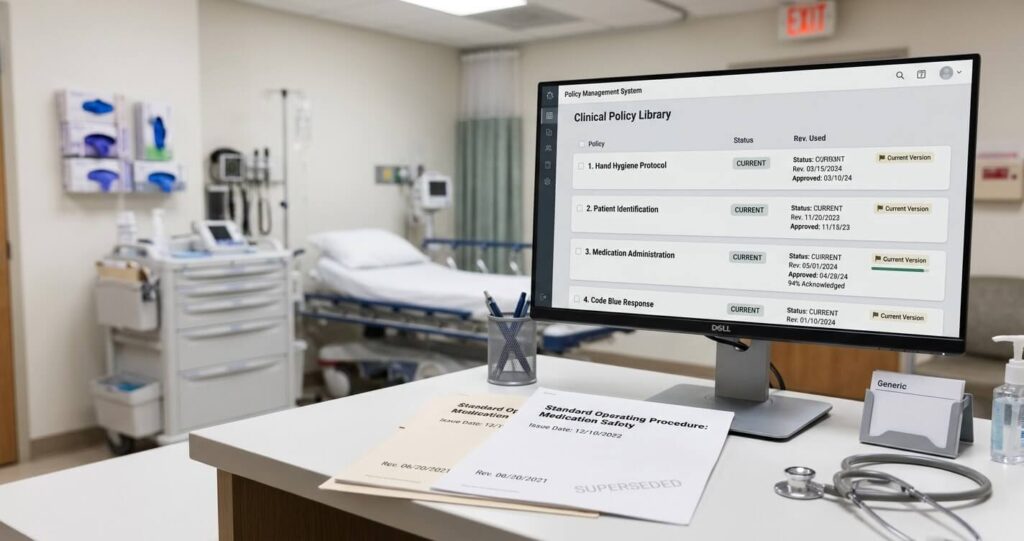
Traditional policy management often focuses on delivery: publish the document, notify employees, collect acknowledgments, and store the record. While those steps are important, they do not necessarily demonstrate comprehension.
A stronger approach connects policies with training, testing, reminders, and reporting. Instead of treating compliance as an occasional administrative task, organizations can make it part of an ongoing workflow.
This is particularly important for decentralized organizations where departments, facilities, or satellite locations may have different responsibilities. A centralized compliance platform can help create consistency while still allowing organizations to manage relevant requirements across different teams.
Turn Policies Into Active Learning Experiences
One way to improve comprehension is to supplement written policies with modular eLearning content. Employees can receive focused training that reinforces the most important concepts instead of relying exclusively on lengthy documents.
We designed ComplyVision to support this type of connected approach. Our platform can associate policies and standards with related training materials, testing, documents, videos, and other resources. This allows organizations to move from simply asking employees to read a policy toward giving them opportunities to demonstrate understanding.
Modular training can also make ongoing education easier to manage. When requirements change, organizations can update the applicable content and direct employees toward the material they need.
Use Automated Reminders to Maintain Accountability
Even well-designed training can become ineffective when follow-up depends entirely on manual tracking. Employees may miss deadlines, departments may overlook outstanding acknowledgments, and compliance teams can spend valuable time chasing individual responses.
Automated reminders help create a more consistent cycle. ComplyVision supports notices and reminders that can direct staff to policies, training materials, acknowledgments, and testing. The platform can also record actions and testing results, creating an auditable history of participation and understanding.
This shifts the process from “Did we send the policy?” to more meaningful questions: Who completed it? Who still needs training? Who may need additional education?
Make Testing Part of the Workflow
Testing can provide another layer of accountability. A policy acknowledgment indicates that an employee received or reviewed information, but a knowledge check can provide additional insight into whether key concepts were understood.
Organizations can incorporate questions, scores, and other testing activities into policy and training workflows. When results identify knowledge gaps, those gaps can become opportunities for targeted education rather than problems discovered during an inspection or incident.
This is where compliance becomes a continuous process rather than a once-a-year exercise.
Practice Readiness Before an Actual Survey
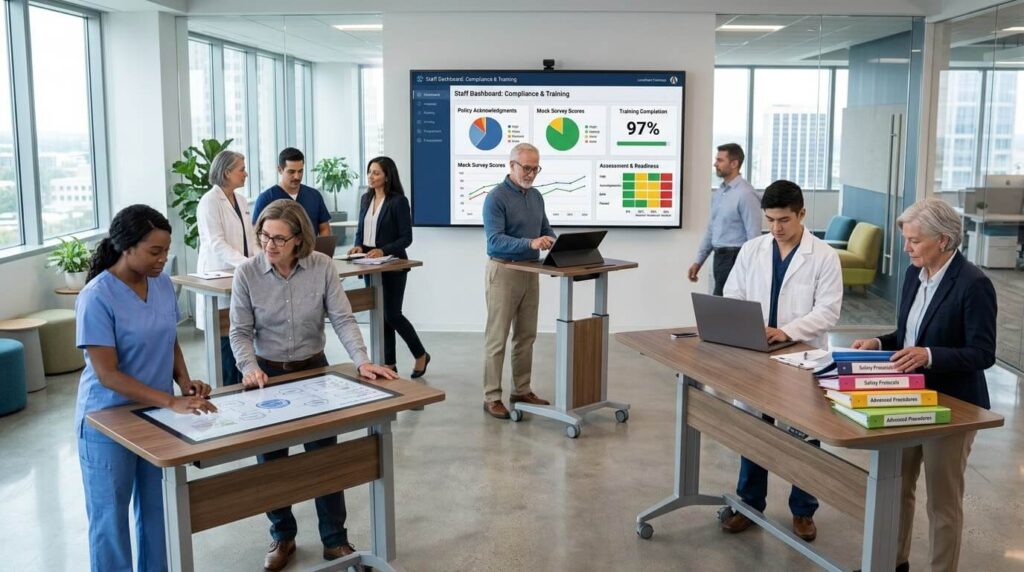
Mock surveys can take the concept even further by helping organizations evaluate preparedness before an external review. Instead of waiting until an audit or accreditation survey is approaching, teams can use simulated readiness activities to identify weaknesses earlier.
ComplyVision includes Mock Survey and staff preparedness capabilities alongside policy management, training, testing, alerts, dashboards, and reporting. These connected features help organizations identify compliance gaps and create a more proactive readiness strategy.
For decentralized organizations, this can also provide greater visibility into readiness across facilities and departments.
Build a Continuous Culture of Compliance
The goal of modern staff training and policy testing workflows is not simply to create more documentation. It is to build a system where policies, education, testing, reminders, and readiness activities support one another.
We built ComplyVision as a cloud-based, accreditation-agnostic compliance solution that helps organizations manage policies, standards, training, testing, alerts, mock surveys, and reporting through a connected platform.
For organizations looking to modernize staff training and policy testing workflows, including nearby communities and decentralized facilities, we at ComplyVision can help create a more organized approach to compliance, readiness, and accountability. Contact us at inquiries@filevision.net to learn how our platform can support your organization.