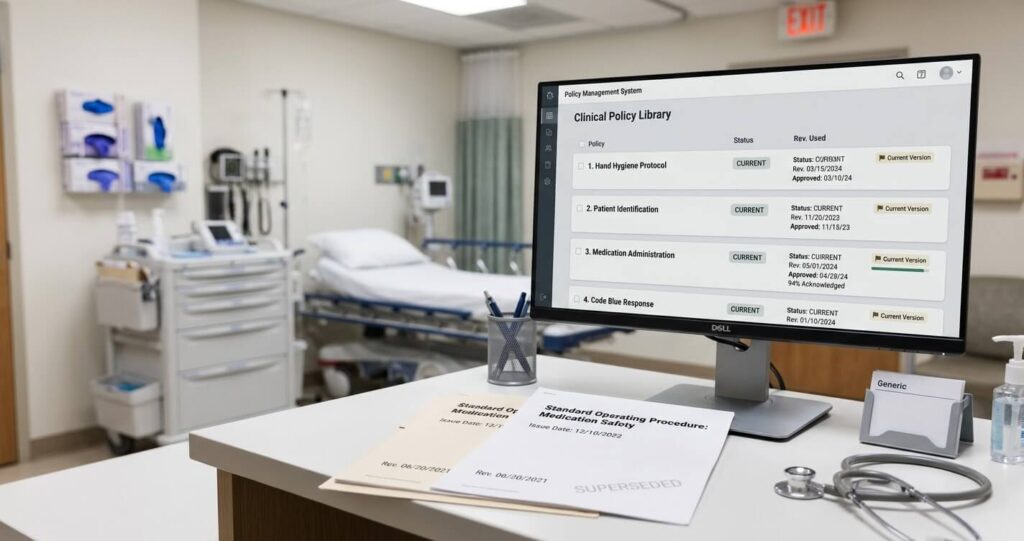

A policy revision does not become usable across a hospital or large clinic simply because someone saves a new document. Compliance and quality teams need to know which version applies, which departments are affected, who must review a change and how staff will receive the final instructions.
A useful handoff is a concise record of decisions and next actions. It allows a department lead to continue an authorized process without mistaking a draft for an approved policy.
State the version and decision status
Start with the policy title, identifier and current approved version. Identify the proposed revision separately. Record whether it is being drafted, reviewed, approved, distributed or monitored under the organization’s existing workflow.
Explain what prompted the revision and which sections changed. If a committee, manager or designated reviewer must decide something, mark that decision as pending. Never describe a proposed instruction as operational policy before its required approval.
Identify departments and dependencies
A change that seems local to one department may affect a handoff elsewhere. List the units or shared functions that use the policy and ask department leads whether the revision changes their work, referenced forms or training materials.
Maintain a compact decision log with the department, designated contact, question and disposition. This supports coordination without replacing the organization’s own policy governance.
Check standards and related instructions
Review whether the policy points to an internal control, standard, procedure or related document. A staff member preparing the revision should flag mismatched references before distribution instead of quietly assuming the older reference remains correct.
For teams using ComplyVision, the platform’s overview of compliance tracking provides context for organizing connected records. The team still needs to verify that each relationship reflects the organization’s current, approved requirements.
Plan distribution and acknowledgment
Name the staff groups that need the final version and the distribution method the organization has authorized. Record what acknowledgment or training, if any, has been required. Identify the official location of the final copy and the treatment of superseded versions.
A notification can prompt attention, but it does not establish understanding. The responsible manager should review exceptions, unanswered questions and next steps rather than interpreting a distribution count as proof of implementation.
Test the handoff before closing it
Ask a designated contact from each affected department to locate the current version, distinguish it from the draft and find any revised form or procedure. Record access problems and questions in the working log.
Where an issue remains unresolved, give it a named responsible staff member and a follow-up date. Keep open questions visible rather than declaring the policy update complete because the document was uploaded.
Preserve a usable change history
Retain the prior approved version, decision record, distribution evidence and outstanding exceptions according to applicable organizational records rules. A clean closeout identifies who confirmed the work and what still requires attention.
The aim is not a longer checklist; it is fewer ambiguous decisions at the next departmental handoff. For a broader description of task and document workflows, see how ComplyVision works.