
An open corrective action should not become difficult to follow simply because the staff member responsible for it is taking planned leave. For compliance and quality teams in hospitals and large clinics, the goal is a handoff that tells the designated backup what is happening, where to find the record, what must happen next and when to escalate.
A useful handoff is not a declaration that the finding is closed. It is a short, verifiable continuity record that preserves decisions, evidence and accountability while the assigned staff member is away.
Start with one current issue and status
Identify the corrective-action record and describe the issue in operational terms. State whether the action is awaiting review, underway, blocked, ready for verification or closed according to your organization’s own status definitions. Record what has already been completed, what remains open and which decision is outstanding.
Avoid a vague entry such as “in progress.” A backup should be able to tell the difference between a task awaiting a document, a task awaiting an authorized decision and a task that is complete but still needs effectiveness review.
Point to the evidence, not a scavenger hunt
Provide the approved record location and the specific evidence needed for the next step. Name the document, version or record identifier when useful, and note whether the evidence has been reviewed or is still being collected. Use approved access-controlled locations rather than copying sensitive material into an email or leave calendar.
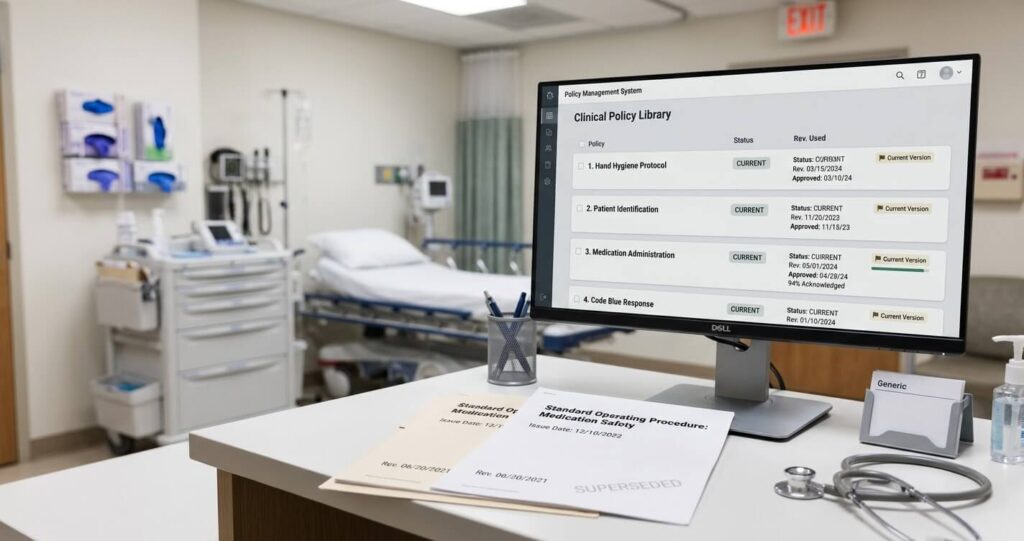
ComplyVision’s corrective-action and document-tracking capabilities can support a shared reference point, while the team remains responsible for confirming that the record is accurate and accessible.
Make the next deadline and decision explicit
List the next internal or externally imposed due date exactly as it appears in the governing record, along with the action due on that date. Distinguish the next checkpoint from the final closure target. If the deadline has not been confirmed, flag it for verification rather than inventing one.
Specify what the backup may prepare, what requires a designated approver and what must be escalated. A task alert can help draw attention to a checkpoint, but an alert does not replace a person’s acknowledgment or an approved responsibility assignment.
Name the backup and test access before leave
Record one named primary backup, the relevant role and a practical alternate if the primary backup is unavailable. Confirm that the person has accepted the handoff and understands the next action. A name on a checklist is not proof of consent, authority or capacity.
Before the assigned staff member goes on leave, ask the backup to open the corrective-action record, locate the supporting evidence and identify the next required update. Check access using the organization’s approved permissions process. Do not share credentials or assume the software automatically reassigns responsibility for the corrective action.
Define an escalation route for stalled work
Identify the person or role to contact if the deadline is at risk, evidence conflicts, a safety or compliance concern emerges, or the backup lacks authority to proceed. State how an escalation is recorded and who can decide whether the action plan needs revision.
Keep this route consistent with existing organizational policies. The handoff checklist should make escalation easier to execute, not create a new clinical protocol or regulatory threshold.
Use a seven-point departure check
Before leave begins, confirm: (1) the issue and current status are understandable; (2) the evidence location is specific; (3) the next action and deadline are recorded; (4) a named backup has accepted responsibility for the agreed tasks; (5) access has been tested; (6) the escalation contact and trigger are clear; and (7) a return-to-work reconciliation is scheduled.
Where teams use ComplyVision, its dashboards, task notifications and reporting tools may help them review outstanding work. The handoff still needs an explicit human confirmation of who will act during the absence.
Reconcile the record when the staff member returns
On the first practical return-to-work review, compare the handoff snapshot with the current corrective-action record. Ask what changed, which deadlines were met or revised, what new evidence arrived, which decisions were approved and which escalations remain unresolved.
Confirm which staff member is responsible for the corrective action and agree on the next step with the backup before treating the handoff as complete. Preserve the change history; do not overwrite the period of temporary coverage or silently mark the action closed.
Continuity is the measure of a good handoff
The best handoff is short enough to use and specific enough to act on. It gives a backup a reliable starting point without pretending that a checklist grants authority, verifies effectiveness or guarantees a survey outcome. For a broader view of how the platform organizes compliance work, see ComplyVision’s overview of corrective-action tracking; for the workflow context, explore how ComplyVision works.