When accreditation or regulatory surveyors arrive on a nursing unit — for a Joint Commission visit, a CMS survey, or a state health department inspection — they rarely ask for everything at once. They ask the charge nurse or unit manager for a specific policy, a specific log, or proof that a past finding was fixed, and they notice how long it takes to produce it. A unit-level evidence folder turns that moment from a search into a handoff.
This checklist is a practical healthcare compliance aid for clinical leaders. It does not replace your organization’s policies, your accreditor’s current standards, or guidance from your quality and regulatory team. It does help the unit show, quickly and consistently, that its written processes are followed in daily care.
Map the folder to the standards and tracers your unit expects
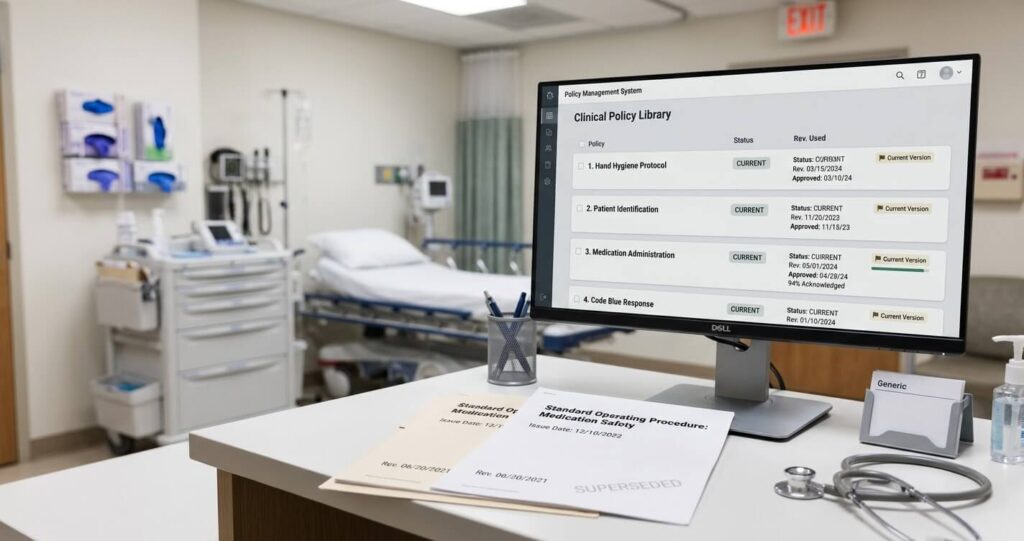
Start with what your last survey, mock survey, and internal rounds emphasized for this unit type. Place the current approved versions of the matching clinical policies at the front — for example medication storage, infection prevention, patient identification, and fall prevention. Keep effective dates and approval signatures visible so no one has to open the policy library to confirm which version is live.
Keep the logs that prove the policy is followed
Surveyors often compare a written policy with the records that show it is practiced. Medication-refrigerator and blanket-warmer temperature logs, crash-cart checks, eyewash station checks, infection-control rounding, and hand-hygiene observations belong in the folder, with dates, initials, and any out-of-range actions documented. If a log lives in an electronic system, export a dated copy and note where the live record sits.
Show staff competency and licensure in one place
Unit managers should be able to show current licensure verification, required competencies, annual education, and orientation records for the staff on the schedule. A simple roster that points to where each record is stored is often enough. What matters is that the unit can produce it without calling three departments.
Pull Environment of Care evidence together
Include recent Environment of Care rounds for the unit, open work orders for items such as damaged surfaces or blocked corridors, and any unit copies of fire or emergency drill records. Clean and soiled utility rooms, storage clearances, and labeling are common stops on a walk-through, so note when each was last checked and by whom.
Track open and closed Plans of Correction with proof
For each prior finding tied to the unit, include the Plan of Correction or corrective-action plan, the accountable owner, target dates, and the monitoring data that shows the fix held. Closed items need verification evidence, not just a status note. Dedicated healthcare compliance and mock survey tools help quality teams keep that trail connected instead of rebuilding it the night before a survey.
Version-control the folder and rehearse retrieval
Date the folder, name the compiler, and remove superseded documents so a surveyor is never handed two versions of the same policy. Then run a short drill: have a colleague request three random items while you time the retrieval, on day shift and on night shift. Gaps found in a mock tracer are far easier to close than gaps found during the real one, and ComplyVision’s compliance tracking workflow makes those readiness checks easier to repeat across units.
Build the charge nurse and unit manager handoff
Survey activity does not wait for the unit manager to be on site. Make sure every charge nurse knows where the folder lives, what is inside, which items are still pending, and who to call for records the unit does not hold.
- Current clinical policies mapped to expected standards and tracers
- Dated temperature, equipment, and infection-control logs with corrective actions noted
- Staff licensure, competency, and education records for the unit
- Environment of Care rounds and open work orders
- Open and closed Plans of Correction with monitoring evidence
- Named folder owner and charge nurse handoff for survey day