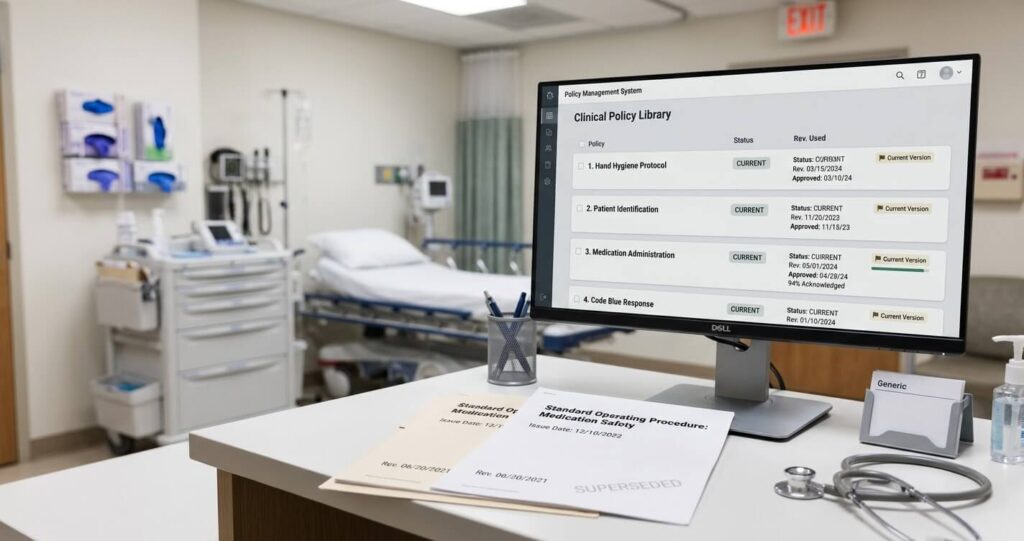

A dashboard shows 90 percent completion. Before carrying that number into a leadership meeting, ask what it counts. Does it cover everyone assigned the activity, only people whose deadline has passed, or one department? Are recent transfers included? Two reports can display the same percentage while describing different situations.
For healthcare compliance and operations teams, a short definition check can make reporting more useful. Start with one recurring measure and agree on its scope before using it to compare facilities or reporting periods.
Write the measure in an ordinary sentence
Replace a broad label such as “training complete” with a definition that names the activity, population and cutoff. For example: “Employees assigned this module, with a due date on or before the reporting cutoff, who have met the recorded completion criteria.”
Then state the denominator: the full group that belongs in the calculation. Decide how the organization handles transfers, leave, duplicate assignments and approved exceptions. Those decisions should follow the relevant internal procedures rather than being improvised to improve a result.
Keep the definition accessible to people reading the report. A colleague should not need to find the original report builder to understand what a percentage represents.
Check the population before interpreting the percentage
Consider a fictional example. A report shows 72 completed assignments out of 80 included assignments, or 90 percent. The team then discovers 10 additional assignments that meet the same eligibility and due-date rules but were omitted from the report. None is complete. The corrected result is 72 out of 90, or 80 percent.
The work did not suddenly become less complete. The report’s coverage changed. That distinction matters when leaders decide where follow-up is needed.
Compare the included group with the agreed source of assignment information. Record unresolved differences, and make missing data visible. An unknown status should not silently become “complete” or disappear from the population without an explained rule.
Separate completion from the meaning attached to it
An acknowledgment, a finished learning module and a passed assessment describe different activities. Use the completion criteria established for the measure, and avoid treating one as proof of another.
For example, a record that someone opened a policy does not by itself show how that person applies the procedure at work. A completion percentage is a view of recorded activity within a defined scope, not a blanket statement that an organization meets every applicable requirement.
ComplyVision’s compliance management platform includes tasks, acknowledgments, training, dashboards and scheduled reports. Defining what each measure should mean remains an important part of configuring and using those capabilities.
Make time and comparisons explicit
Distinguish the reporting period from the time the data was last refreshed. A report downloaded today may describe a prior cutoff. A late completion may appear differently in a current view and a preserved month-end view.
Before comparing two facilities, check that they use the same activity definition, cutoff and inclusion rules. Where their responsibilities differ, separate the measures or explain why a direct comparison would be misleading.
When a definition changes, note the change beside the result. Do not present a difference caused by revised coverage as evidence of improved or declining performance.
Bring a traceable example into the report review
Choose a small, authorized sample and follow each included record back to its assignment and completion evidence. Confirm that another reviewer can reproduce the calculation using the written definition. Keep employee details within approved access boundaries, and use aggregate information when individual records are unnecessary.
Review ComplyVision’s dashboards and reporting workflows with that example in hand. Discuss how the proposed setup would show the population, cutoff, exceptions and refresh timing. A clearly defined measure gives the next meeting a better starting point for deciding what needs attention.