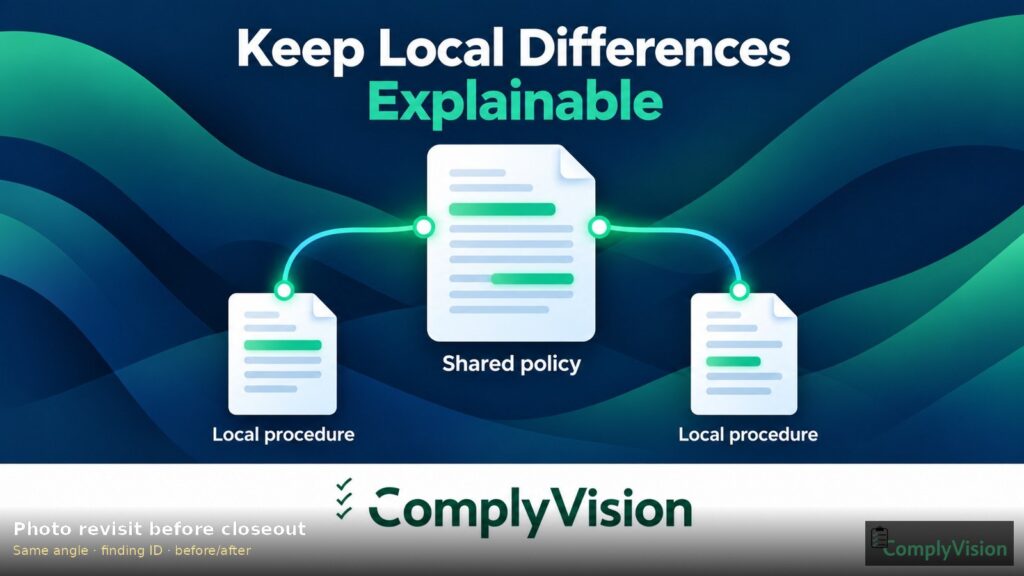
Closing a corrective action on a photo that no longer matches the floor is how findings reopen. Before you mark an action complete, revisit the evidence photos with the same angles, the same location cues, and a same-day link back to the finding ID.
This checklist supports ComplyVision mock-survey and corrective-action workflows. It is not legal advice. ComplyVision’s mock survey and corrective-action management tools work best when photo revisits are scheduled into the closeout, not left to memory.
Pull the original finding photos before you walk
Open the corrective-action record and export or print the photos that first documented the gap. Note the date, photographer, and any location cue already on file. Do not start a revisit until you can hold those originals next to what you are about to shoot.
If the originals are missing location cues or finding IDs, fix that metadata gap in the record before you claim a new photo set is “better.”
Revisit with the same vantage points
Stand where the first photographer stood. Match height, distance, and the portion of the room or equipment that was in frame. A prettier close-up of a different corner does not prove the cited condition is gone.
Take at least one wide shot that shows the same landmarks (doorframe, unit number, equipment tag) and one detail shot that targets the cited defect. Label both with the finding ID the same day.
Separate “still open,” “fixed,” and “cannot recreate”
Some conditions cannot be re-photographed because the work removed the evidence (a replaced fixture, a painted wall). Write that limitation in the action note, attach the approved alternative evidence (work order or invoice), and have a second reviewer verify the alternative package against the acceptance criteria for that finding. An invoice or work order alone does not prove effective resolution. Do not invent a staged “after” photo that never existed on the floor.
If the condition remains, leave the action open and schedule the next revisit date. Closing on hope creates a survey-week surprise.
Require a same-day finding-ID link on every revisit file
Camera-roll filenames will not survive staff turnover. Rename or tag each revisit file with the finding ID and upload it into the same corrective-action record within the same calendar day. Orphan folders on a shared drive are not closeout evidence.
ComplyVision’s compliance dashboards and reporting workflows only help if those links stay attached to the action they claim to close.
Compare before and after side by side before you sign
Place the original finding photo next to the revisit photo in the record. Ask a second reviewer who did not take either photo whether the same area is shown and whether the cited condition is visibly resolved. If the second reviewer cannot tell, re-shoot.
- Same vantage and landmarks
- Finding ID on both files
- Date and photographer logged
- Second-reviewer initials on the pair
Do not reuse walkthrough photo rules as the revisit checklist
Initial evidence-photo rules cover how to capture a finding the first time. A corrective-action photo revisit answers a different question: does the floor still match the claim that the action is done? Keep those checklists separate so closeout staff do not skip the comparison step.
Schedule the revisit on the action plan, not in a hallway reminder
Put the revisit date, owner, and required photo count on the corrective-action plan when the action is opened. Hallway reminders disappear when the owner is out. If the revisit date slips, record the slip and the new date in the same record.
Close only when the photo pair and the work proof agree
Close when the matching before/after photo pair and the linked work order agree — or, when recreation is documented as impossible, when the approved alternative-evidence package and reviewer verification against acceptance criteria are complete. A clean revisit photo without a work order, a work order without a matching photo pair, or an invoice/work order alone without documented limitations and reviewer verification, is incomplete closeout evidence. Require both the matching before/after photo pair and the linked work order before the action owner and the quality lead initial closeout, except where the record documents that recreation was impossible and the alternative-evidence path above was followed.