A mock survey ends with a finding and a promise to fix it. Two weeks later, the action is marked complete. What changed, and how was the result checked?
A useful corrective-action record makes those answers visible. It connects the original observation to the work performed and the evidence reviewed before closure. For healthcare quality and compliance teams, that record can make a follow-up meeting more productive than a list of green status boxes.
Write down the observation before interpreting it
Capture what the reviewer actually saw, where it occurred, when it was observed and which part of the review it relates to. Keep the observation separate from a possible explanation.
“Staff need more training” jumps straight to a proposed response. A more useful starting point might be: “During an internal retrieval exercise, the requested equipment-check record for the selected date could not be located.” That description leaves room to determine whether the record was missing, filed elsewhere or difficult to retrieve.
Identify the relevant internal procedure or review criterion and its version. Do not assume that an observation establishes a regulatory violation. The appropriate subject-matter owner should determine its significance and which requirements apply.
Separate an immediate correction from the underlying issue
Finding a misplaced record may resolve the immediate request. It does not explain why the record was difficult to locate. Before deciding on an action, review the process with the people who do the work.
Was the filing location unclear? Were naming instructions inconsistent? Did the reviewer have the appropriate access? Was a required step missed? Record what the review establishes and distinguish confirmed facts from open questions.
If an observation raises an immediate safety concern, follow the organization’s escalation procedures promptly. The routine documentation process should not delay an urgent response.
Describe a change that someone can verify
Replace a broad action such as “improve documentation” with a specific change, an accountable owner and a target date appropriate to the issue. Identify any other team whose input is needed.
Decide how the action will be checked before it is marked complete. A revised instruction, a staff briefing and a successful retrieval exercise answer different questions. Choose evidence that fits the problem rather than attaching whatever is easiest to collect.
ComplyVision’s mock survey and corrective-action management tools are part of a broader platform for managing compliance information, tasks and reporting. Your team still needs to define what an adequate response looks like for the finding being reviewed.
Keep completion and verification separate
The person assigned to an action may finish the work before the designated reviewer has checked it. Keep those stages distinguishable in the record, using the status labels your organization has approved.
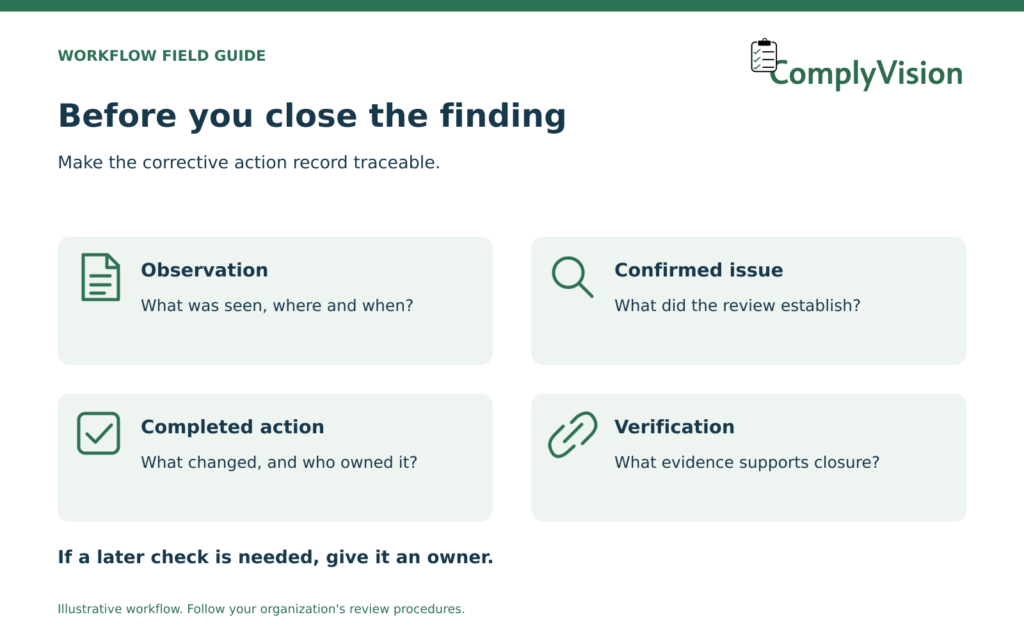
A simple illustrative example shows the difference:
- Observation: a selected equipment-check record could not be located during an internal retrieval exercise.
- Confirmed cause: after review, the team found inconsistent folder naming.
- Action completed: the responsible team clarified the filing instruction and corrected the affected folder names.
- Verification: the designated reviewer repeated a defined retrieval exercise and recorded what was found.
- Follow-up: the team set a later check to see whether the naming approach continued to be used.
This fictional example illustrates record structure, not a prescribed corrective action or proof that a compliance requirement has been met. The scope of review, supporting evidence and closure authority should match your organization’s procedures and the issue involved.
Make closure explainable to another reviewer
Before closing an item, check whether a colleague can trace the observation, the confirmed issue, the completed action and the verification result. If the evidence does not support closure, record what remains open and who will handle it.
Reference supporting material in its approved location. Limit the record to the information needed for review, and avoid copying patient details or other sensitive information into broadly accessible notes or attachments.
When ongoing effectiveness matters, identify who will conduct the later check and how a recurring issue will be reopened or escalated. Closing the original action should not erase that next responsibility.
Bring one finding to a workflow review
Choose a recent, appropriately de-identified mock-survey finding and walk through its record with the action owner and reviewer. Identify the point where the evidence becomes difficult to follow.
Review ComplyVision’s compliance dashboards and reporting workflows with that example in mind. Ask how the proposed configuration would show completed work, pending verification and later follow-up without losing the connection to the original observation.
A clear record gives your team a better basis for deciding when an action is ready to close and what still needs attention.