
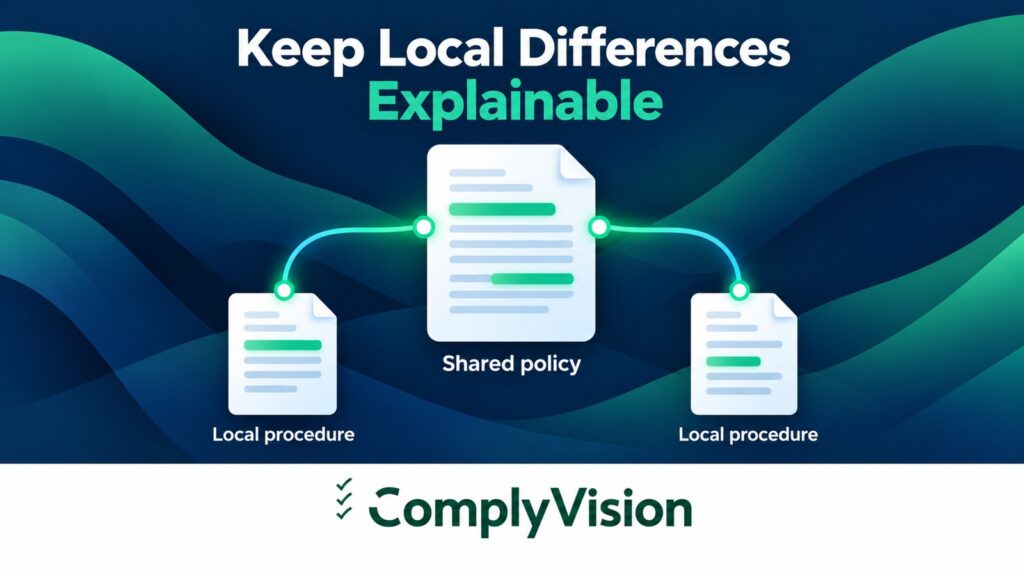
A shared policy applies across several locations, but each site has different contact details, equipment or operating arrangements. One team edits a local copy to make it useful. Another keeps an informal instruction sheet. Soon, readers cannot tell which differences were reviewed and which appeared by accident. Local policy variation management begins by distinguishing a legitimate local procedure from an unapproved change to a shared requirement. The appropriate organizational owners need to define that boundary and keep the relationship visible.
Establish what must remain common
Identify the organization-wide policy and the parts that apply consistently across the relevant sites. The responsible policy, clinical or compliance owners should determine the shared requirements and whether local variation is permitted. Do not assume that a practical local preference can override an applicable requirement. Where the question involves different legal, regulatory or accreditation obligations, route it to the qualified subject-matter owner for review. The document structure should record the decision, not make the decision on its own. Write down the scope clearly. Readers should be able to tell which locations, services and roles the shared policy covers before interpreting an attached local procedure.
Explain each approved difference
For a local variation, record what differs, why it is needed and who approved it. Identify the local scope and relevant effective date. A note saying "site-specific" may be insufficient for a reader trying to determine whether the instruction applies to their work. For a fictional administrative example, an organization-wide records request policy may be supported by different approved contact routes at two locations. The underlying requirement can remain shared while the local routing details differ. This is an illustration of document structure, not a prescribed healthcare policy. Use the ComplyVision policy management overview to frame a discussion of the relationships your organization needs to maintain between common and local material.
Avoid a separate uncontrolled copy of the whole policy
Copying the entire policy into a local document creates another place where every future change must be reviewed. Where the organization's governance permits it, consider keeping the local detail in a clearly linked procedure or appendix instead. The right structure depends on the actual requirements and implementation. The important point is that a reader can reach the shared policy and identify the reviewed local instruction without guessing which document has priority. Check how staff actually find the material. A well-organized central collection will not resolve conflicting guidance if a team continues using an old printed sheet or saved attachment.
Review local effects when the shared source changes
A revision to the shared policy may affect several local procedures. Identify who is responsible for evaluating that impact at each location and how unresolved questions will be escalated. Keep the affected items visible until their review is complete. The same care applies when a local operating arrangement changes. A new contact route, responsibility or process may require review of the local document even if the shared policy has not changed. Discuss ComplyVision policy versioning and review workflows with these two directions of change in mind. Confirm how the proposed configuration will support the relationships, assignments and status information your owners need.
Test one reader journey across two locations
Choose a common task and ask authorized staff at two sites to locate the applicable instruction. Can each person identify the shared policy, local scope and current version? Can a reviewer trace the reason and approval for a difference? Compare the findings without assuming every difference is a defect. Some may be necessary; others may reveal an unreviewed copy or unclear instruction. Assign the appropriate review rather than standardizing by deletion.
A useful policy structure makes approved differences explainable while keeping the common requirements visible. Start with one policy family and resolve its relationships before expanding the approach across the organization.